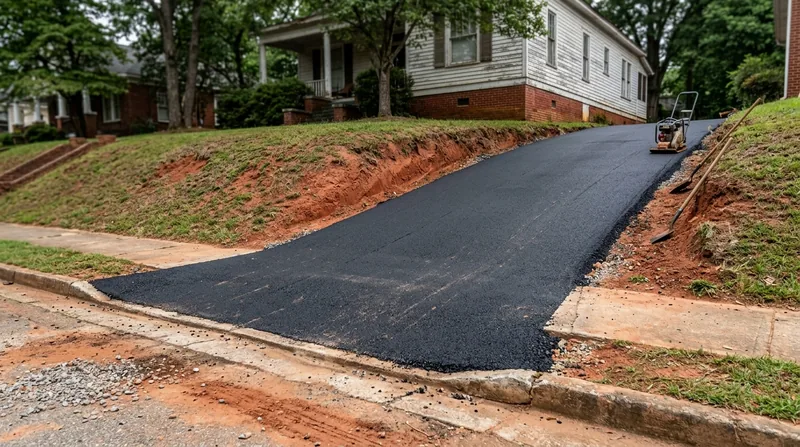




Driveway Extensions, Widening & Aprons in Columbus solve a problem that hits every neighborhood differently. Uptown and Midtown historic homes sit on steep red clay slopes where a short apron climbs from the street at an angle that sheds rain but leaves little room to turn a truck or park a second car. Mid-century ranches across Muscogee County sprawl on wider lots, but the Piedmont clay underneath stays soft after afternoon thunderstorms, and a driveway that wasn't graded with a real base shifts within a season. North toward Harris County, builders are still cutting into clay hillsides with narrow aprons that need widening and reinforcement. South of downtown, the coastal plain sand drains fast but slumps without edge work and confinement. We widen the base, tie in a new butt joint, and pitch the apron so it sheds rain off the street and into the drainage path where it belongs.
Why Driveway Extensions and Widening Matter in Columbus's Terrain
Columbus sits on the Fall Line, and that geographic fact shapes how driveways age and fail. The red clay and sandy clay soils that underlie the city's neighborhoods move with water and temperature. A driveway that looked fine for five years can crack and settle when the base is too thin or when water runs under the edge instead of off it. Widening an apron and installing proper edge confinement stops that water from undermining the asphalt, and it gives you the room you actually need to park a second vehicle or back out without scraping the street.
- Short, steep aprons in Uptown Columbus need real edge work on red clay slopes to prevent erosion and settling.
- Wider aprons reduce the pitch angle and improve drainage flow away from the driveway perimeter.
- Proper grading and base preparation prevent water from pooling under the asphalt and causing premature failure.
- A widened apron adds functional parking space without requiring a full driveway replacement.
- Extending the apron onto the property line (where permitted) reduces street parking pressure in older neighborhoods.
Getting a written estimate that includes the tonnage of asphalt, the depth of base, and the specific grading work lets you compare apples to apples and understand what you're paying for.
Key info: Columbus requires permits for driveway aprons, curb cuts, and any work that affects stormwater runoff. The city of Columbus and surrounding municipalities each have their own rules. Before any excavation, Georgia 811 utility locates are required by law. Contact your local building department to verify permit requirements and setbacks for your address.
How We Widen and Extend Driveways in Columbus: The Process
Widening an apron or extending a driveway starts with understanding what's underneath and what the site requires. We measure the existing driveway, identify the soil type and drainage, and plan the extension so it ties into the existing apron with a strong butt joint, not a weak seam that will crack. We remove the old edge if it's damaged, we prep the base with compacted stone or recycled asphalt, and we lay new asphalt at the same thickness and pitch as the original driveway so rain runs off and not into the foundation or the street.
- We measure the existing driveway and survey the slope and drainage to plan the extension or widening.
- We call for a Georgia 811 utility locate to mark all buried lines before any excavation begins.
- We remove the old edge asphalt and any unstable soil down to firm bearing, compacting the base layer in lifts.
- We install recycled asphalt millings or new stone base, proof-rolling to ensure it will not move under the new asphalt.
- We lay hot mix asphalt at the proper thickness and pitch, tying the new section to the old with a milled or beveled joint.
- We allow the asphalt to cure for six to twelve months before sealing, so the binder can fully set.
The result is a wider, more functional apron that sheds rain, supports parking, and lasts as long as the original driveway. See our full approach to asphalt driveway paving and installation for more detail on how we lay and finish new asphalt.
Local example: A 1950s ranch in Midtown Columbus had a narrow 10-foot apron that turned into a parking nightmare when a second car joined the household. The driveway sat on soft clay and was starting to crack at the edges where water was pooling. We widened the apron from 10 feet to 14 feet, added four inches of recycled asphalt base, and laid three inches of hot mix. The new section tied to the old with a clean milled joint. Cost ran $2,400 for materials and labor. The owner now has room to park both cars off the street and the driveway sheds rain properly.
Driveway Extension Methods: Widening, Aprons, and Turnarounds
| Approach | Description | Best For |
|---|---|---|
| Apron Widening | Extend the existing driveway 2 to 4 feet on one or both sides, tying to the original with a milled butt joint. | Adding parking space without full replacement; improving drainage on narrow aprons. |
| Apron Extension | Extend the apron further up the slope or down toward the street, adjusting pitch and base depth to match site drainage. | Steep Uptown driveways; reducing the angle and improving usable surface; meeting setback requirements. |
| Turnaround or Parking Bay | Add a 12 to 16 foot wide turnaround or bay at the end of the driveway so vehicles can turn without backing onto the street. | Long driveways; rural properties; HOA roads; improving safety and functionality. |
| Edge Reconstruction | Remove failed edge asphalt and unstable soil, rebuild the base with compacted stone, and lay new asphalt with proper edge confinement. | Soft clay soils (common in Muscogee County); water pooling at edges; preventing future slumping and cracking. |
| Recycled Asphalt Base | Use recycled asphalt millings as the base layer under new asphalt, compacting in lifts to proper density. | Budget-conscious widening; sustainable base prep; coastal plain sandy soils that need confinement. |
Each method depends on the site's soil type, drainage, and what the existing driveway looks like. We'll recommend the approach that gives you the most value and the longest service life.
Driveway Extensions, Widening & Aprons Cost in Columbus: What to Expect
A basic apron widening or extension in Columbus starts at $1,800 and moves up from there depending on how much new asphalt you need, how deep the base has to be, and what the soil looks like. A 4-foot widening on a 12-foot-wide driveway for 20 linear feet is roughly 960 square feet of new asphalt. If the base is stable, you're looking at four inches of recycled asphalt millings and three inches of hot mix. If the soil is soft clay and needs deeper prep, or if you're extending the apron up a steep slope where we have to do more grading, the cost climbs. A turnaround or parking bay runs higher because it's more square footage and more base work.
The factors that move the price up are:
- Soil type and drainage: soft clay and coastal plain sand need thicker or more robust base layers than stable ground.
- Slope and grading: steep Uptown properties need more excavation and compaction than flat suburban lots.
- How far you're extending: a 4-foot widening costs less than a 20-foot turnaround.
- Existing edge condition: if the old edge is damaged and needs removal, add labor and material.
- Utility work and permitting: if a utility locate reveals lines in the path, or if permits require inspections, costs go up.
The best way to understand your cost is to get a written estimate that spells out the square footage, the tonnage of asphalt and base, and the depth of each layer. We provide free estimates within 24 hours at (706) 641-0717. See our full pricing overview for more detail on what moves costs in different scenarios.
Driveway Extensions, Widening & Aprons Near Me: What Columbus Homeowners Should Know Before Hiring
Hiring the right contractor for a driveway extension or widening means checking credentials, getting multiple estimates, and understanding what's included in the price. A fully insured contractor carries liability coverage if something goes wrong on your property. Ask for references from recent jobs in your neighborhood, and call one or two to hear what the experience was like. Make sure your contractor understands local permit requirements and is willing to work with your city's building department or your HOA if you're in a master-planned community. Get everything in writing, including the square footage, the asphalt thickness, the base depth, and the tonnage specs.
- Ask the contractor for proof of insurance and the names of three references from similar jobs in Columbus or nearby.
- Check with your city or county building department to confirm permit requirements for apron extensions and curb cuts.
- If you live in an HOA community, review the architectural guidelines before you get estimates, since some HOAs restrict driveway materials or size.
- Request a written estimate that includes square footage, asphalt thickness, base material and depth, and tonnage of materials.
- Verify that the contractor has called for a Georgia 811 utility locate before any excavation begins.
- Understand the timeline: a typical widening or extension takes one to two days, and the asphalt must cure for six to twelve months before sealing.
Red flags to watch for: an unsolicited door-to-door offer, no written contract, a request for a large cash deposit upfront, out-of-state plates, a price that seems too good to be true, or an estimate with no thickness or tonnage details. Any contractor, including us, should be able to explain what you're paying for in concrete terms. Call Columbus Asphalt Paving to request a free estimate and to ask any questions about the process.
Driveway Extensions, Widening & Aprons in Columbus: Pricing Guide
| Service | Price | Details |
|---|---|---|
| Apron Widening (4 feet, 20 linear feet) | Starting at $1,800 | Four inches recycled asphalt base, three inches hot mix asphalt, milled butt joint, includes site prep and compaction |
| Apron Extension (up slope or down) | Starting at $2,200 | Includes grading, drainage adjustment, deeper base if soil is soft clay, proper pitch, milled joint to existing driveway |
| Parking Bay or Turnaround (12 to 16 feet wide) | Starting at $3,400 | More square footage and base work; cost varies with existing slope, soil type, and distance from driveway |
| Edge Reconstruction (full edge failure) | Starting at $2,000 | Remove failed asphalt and unstable soil, rebuild base with compacted stone, lay new edge asphalt with proper confinement |
| Estimate and Site Visit | Free | Response within 24 hours, no obligation to book, includes written quote with tonnage and thickness specs |
Indicative pricing, the exact cost depends on square footage, finish, and site access. Free personalized estimate within 24h at (706) 641-0717.


