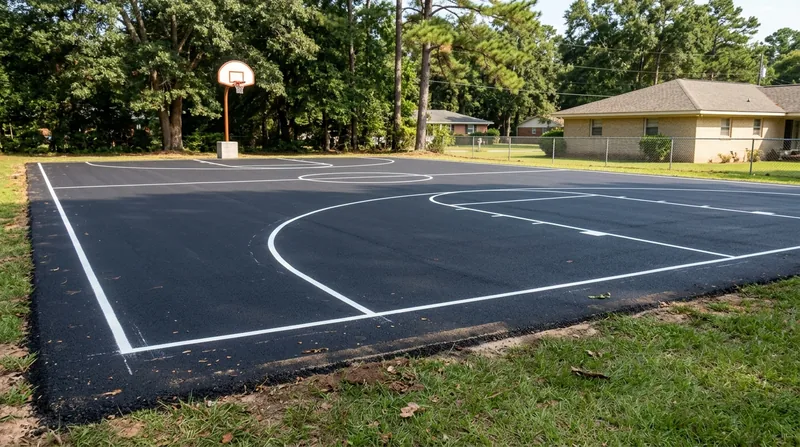




Sports Court & Path Paving in Columbus requires a foundation that handles the region's red clay and sandy soils, frequent afternoon thunderstorms, and year-round UV exposure. Courts across Columbus, from the neighborhoods around Fort Moore to the subdivisions north toward Harris County, sit on ground that shifts and softens after heavy rain. A properly built court surface starts with grading the subgrade, compacting a stable aggregate base, and laying a smooth, well-drained asphalt surface that stays flat for daily play. We have built courts and recreation paths since 2009, and we understand how Columbus soil behaves under load and water. Whether you are adding a court to a school, a community center, a church, or a private property, the base matters more than the top layer. This page covers what goes into a court that plays true, what it costs, and how to choose a contractor who will get it right.
Why Sports Court & Path Paving Matters in Columbus: Drainage, Compaction, and Play Surface
Columbus sits on the Fall Line, where clay soils dominate and water behaves differently than it does on sand or gravel. A tennis court or basketball court built without proper drainage and base compaction will crack, settle unevenly, and become unsafe within one to two seasons. The Piedmont clay that underlies most of Columbus holds water and expands when wet, then shrinks and shifts as it dries. Summer afternoon thunderstorms and tropical system rain dump water fast, and a court that does not shed that water quickly will trap it in the base layer, where it weakens the aggregate and destabilizes the subgrade beneath. A well-built court is graded to shed water, sits on a compacted crushed stone base at least 4 to 6 inches thick, and is paved with smooth, dense asphalt that provides consistent ball response and player safety.
- We grade the subgrade to eliminate low spots where water pools and clay stays soft.
- We compact an aggregate base layer in lifts to create a stable, load-bearing platform.
- We proof-roll the base to confirm it will not settle or shift under court traffic.
- We pave a smooth, dense surface course that provides true ball roll and safe player footing.
- We pitch the court slightly to shed rain and prevent standing water on the playing surface.
A court built this way will perform for 15 to 20 years with routine maintenance. Cutting corners on base preparation is the most common reason courts fail early.
Key info: Columbus building departments and HOAs often require site plans, drainage calculations, and proof of proper base thickness before court construction begins. Verify permitting and architectural standards with the City of Columbus or your HOA before requesting an estimate. We help navigate these requirements.
For more detail on how base preparation affects all asphalt surfaces, see our Gravel Driveway Installation and Grading page, which covers the same compaction and proof-rolling methods that underpin court construction.
How We Build a Sports Court or Recreation Path in Columbus
Court paving is a sequence of grading, compaction, and paving steps that must happen in order. Rushing or skipping steps is why courts fail. We start with a site survey and a conversation about drainage, sun exposure, and how the court will be used. Then we grade the subgrade, removing high spots and filling low spots with compacted soil. We bring in crushed stone aggregate, spread it in lifts, and compact each lift with a vibratory roller until it reaches the density needed to support court traffic without settling. Once the base is stable, we pave the surface course with hot mix asphalt, finishing it to a smooth, level plane with the proper pitch for drainage.
- We survey the site and confirm grading and drainage plans with you and the building department.
- We remove topsoil and grade the subgrade to the proper slope and elevation.
- We deliver and spread crushed stone base material in 4 to 6 inch lifts.
- We compact each lift with a vibratory roller, measuring density with a nuclear gauge or similar method.
- We proof-roll the finished base with a loaded truck to confirm it will not settle under play traffic.
- We pave the surface course with hot mix asphalt, finishing smooth and level with proper pitch.
The entire process, from grading to final paving, typically takes 5 to 10 working days, depending on weather and site conditions.
Example: A church in Warm Springs wanted to add a basketball court to its recreation area. The site sat on red clay and sloped toward a drainage culvert. We graded the subgrade, compacted 6 inches of crushed stone in two lifts, proof-rolled the base, and paved a 50 by 94 foot court with a 1 percent pitch toward the low side. The court has been in daily use for three seasons with no cracking or settlement.
See our Asphalt Driveway Paving and Installation page for more on how we approach base preparation and paving on challenging Columbus soils.
Sports Court & Path Paving Methods: What We Use and Why
| Approach | Description | Best for |
|---|---|---|
| Full-Depth Court Construction | Grade subgrade, compact 4 to 6 inches of crushed stone, proof-roll, pave 2 to 3 inches of hot mix asphalt surface course. | New courts on any soil type, courts where the base has failed or settled, sites with poor drainage. |
| Overlay on Existing Base | Mill or grind the existing asphalt surface, inspect the base for compaction and stability, pave a new 1.5 to 2 inch surface course. | Courts with sound bases but worn or cracked surfaces, where the existing foundation is stable and well-drained. |
| Recreation Path Paving | Grade and compact a 3 to 4 inch aggregate base, pave with 1.5 to 2 inches of hot mix asphalt, pitch for drainage. | Walking and jogging paths, connection routes between courts and buildings, low-traffic recreation surfaces. |
| Recycled Asphalt Base Layer | Salvage and recompact RAP (reclaimed asphalt pavement) from a milling or demolition, use as part of the base layer under new paving. | Cost-conscious projects, sites where a previous asphalt surface is being replaced, environmentally responsible construction. |
Sports Court & Path Paving Cost in Columbus: What to Expect
A new sports court or recreation path in Columbus starts at $8,500 for a small court on a well-prepared site with good drainage and accessible soil. That figure covers grading, base compaction, and a smooth asphalt surface course. Larger courts, sites with poor soil or drainage challenges, or courts that require utility locating and permitting will cost more. A full-size basketball court (50 by 94 feet) typically runs $12,000 to $18,000. A tennis court (60 by 120 feet) typically runs $14,000 to $22,000. A recreation path 10 feet wide and 500 feet long typically runs $6,000 to $10,000. These ranges assume standard crushed stone base, hot mix asphalt surface, and no major site obstacles.
The main factors that move cost are court size, soil type and drainage conditions, distance from the nearest paving plant, and whether the site requires milling or removal of an existing surface. Red clay and sandy soils in Columbus often need more aggressive grading and base preparation than stable, well-drained ground. If the site slopes steeply or has poor natural drainage, we may need to add a drainage layer or cut deeper into the subgrade, which increases material and labor. If you are replacing an existing court, milling the old surface and hauling away the debris adds to the cost, but it often costs less than a full-depth removal.
We provide written estimates that include tonnage, thickness, and material specs so you understand exactly what you are paying for. Get two or three estimates from different contractors before you decide. See our full pricing overview for more detail on what drives cost for different court sizes and site conditions.
Sports Court & Path Paving Near Me: What Columbus Homeowners and Facility Managers Should Know Before Hiring
Choosing a contractor for court or path paving is not a commodity decision. The difference between a well-built court that plays true for 20 years and one that cracks and settles within two seasons often comes down to how much care went into base preparation. Ask any contractor you interview to explain their grading plan, their base compaction method, and how they will proof-roll the finished base. A contractor who can show you a written estimate with tonnage and thickness specs, who pulls permits and coordinates with your building department, and who can name three or four courts they have built in Columbus is more likely to deliver a court that performs.
Verify that any contractor you hire is fully insured and carries workers compensation. Ask for references, and call them. Confirm that the contractor is familiar with Columbus soil conditions and understands how red clay and sandy soils behave under load and water. If your court is part of a facility or HOA, check the architectural standards and permitting requirements before you request an estimate. Some jurisdictions require a site plan, drainage approval, or utility locating. We help homeowners and facility managers navigate these requirements and coordinate with the building department.
Call us at (706) 641-0717 for a free estimate. We will survey your site, walk you through the grading and base plan, and give you a written quote with tonnage and thickness specs. No obligation, no pressure, and we respond within 24 hours.
Sports Court & Path Paving in Columbus: Pricing Guide
| Service | Price | Details |
|---|---|---|
| Small recreation path (500 feet, 10 feet wide) | Starting at $6,000 | Grading, 4 inch aggregate base, 1.5 inch asphalt surface, includes site survey and drainage pitch |
| Basketball court (50 by 94 feet, new construction) | Starting at $12,000 | Full-depth grading, 6 inch crushed stone base, 2 inch asphalt surface, proof-rolling and drainage design included |
| Tennis court (60 by 120 feet, new construction) | Starting at $14,000 | Subgrade grading, 6 inch compacted base, 2.5 inch smooth surface course, site survey and permitting coordination included |
| Overlay on existing court (sound base, worn surface) | Starting at $4,500 | Milling or grinding existing surface, base inspection, 1.5 to 2 inch new surface course, depends on court size and base condition |
| Complex site or large-scale project | On estimate | Challenging soil, poor drainage, utility locating, removal of failed base, or multiple courts require on-site assessment |
| Free estimate | No obligation | Response within 24 hours at (706) 641-0717, includes site survey, written quote with tonnage and thickness specs |
Indicative pricing, the exact cost depends on square footage, finish, and site access. Free personalized estimate within 24h at (706) 641-0717.


